|
|
|
My Research Programme
Many real
world vision tasks such as motion segmentation, large scale scene
reconstruction, and action/scene classification remain challenging research
problems. This is not surprising, considering that more than half of the neocortex is involved in visual processing. To solve these
vision problems robustly, we envisage that it requires a concerted research
effort in integrating the different vision modules together, as well as further
advancing our fundamental understanding of the individual vision modules.
I am
interested to investigate the feedback and lateral links that exist in complex
vision problems. For instance, the segmentation problem will need to combine a
broad range of technical advances in computation of 3D surfaces, knowledge about
natural scene statistics and gestalt laws, and expertise in advanced
mathematical techniques such as level set, graph cut, MRF-based learning. It
provides an opportunity for psychophysical, computational and mathematical
studies that will extend our understanding of the processes underlying the
interactions between various vision modules, as well as the incorporation of
environmental constraints to enhance the performance in dynamic, real-world
situations.
In the
past decade, my research has revolved around the central question of space
perception arising from motion cues, otherwise known as the structure from
motion (SFM) problem. I approach this problem mainly from the computational
perspective but also study the psychophysical implication and some applied
aspects (see the links below). It remains an active area of
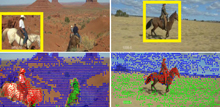
my research. Recently, I address various motion-related problems such as 3D motion segmentation,
tracking, as well as change detection amidst scenes with complicated dynamic behavior
such as swaying trees and undulating waves.
Please note that I no longer take in research students/staff.
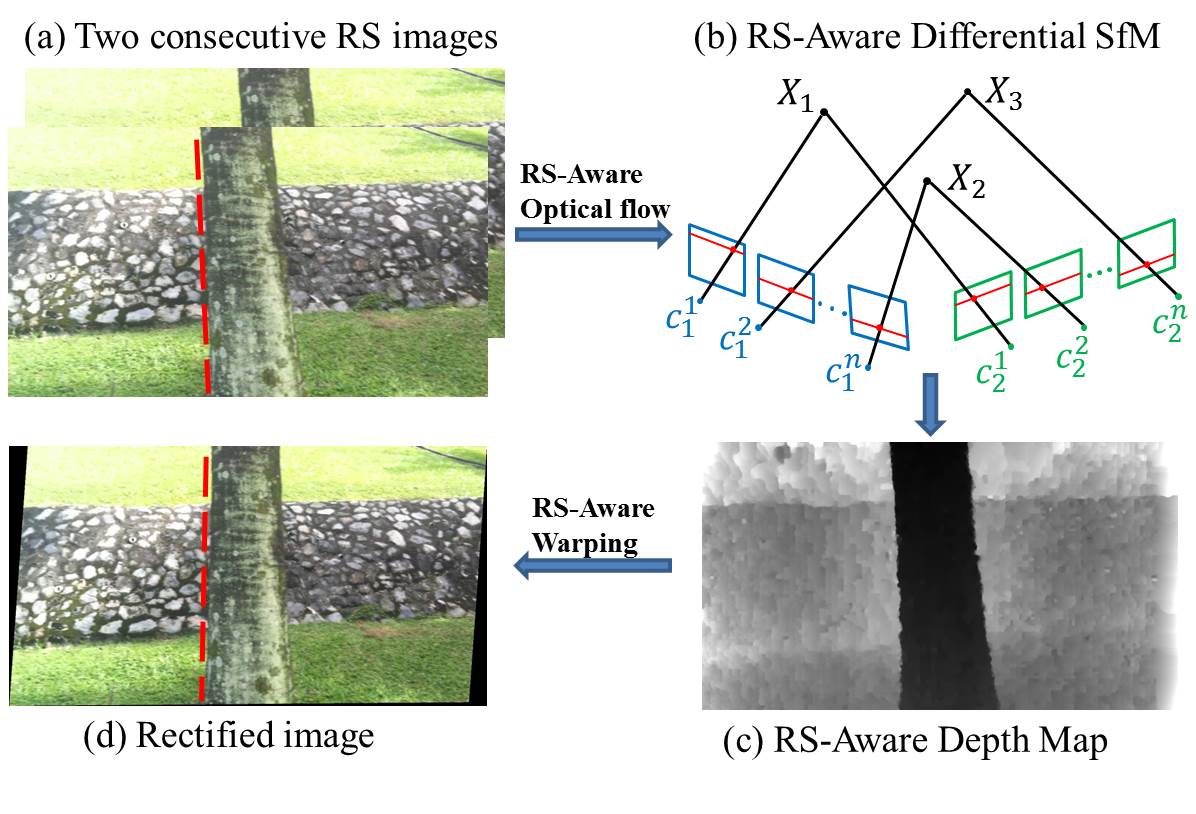
Rolling-Shutter-Aware Differential SfM and Image Rectification
Bingbing Zhuang, Loong-Fah Cheong, Gim Hee Lee.
IEEE International Conference on Computer Vision (ICCV), 2017
[PDF ][Supplementary PDF][Dataset download]
- Propose a modified differential two-frame SfM algorithm for Rolling-Shutter cameras.
- Derive a 8-point/9-point algorithm under mild motion assumption.
- Put forth an image rectification method that outperforms commercial software.
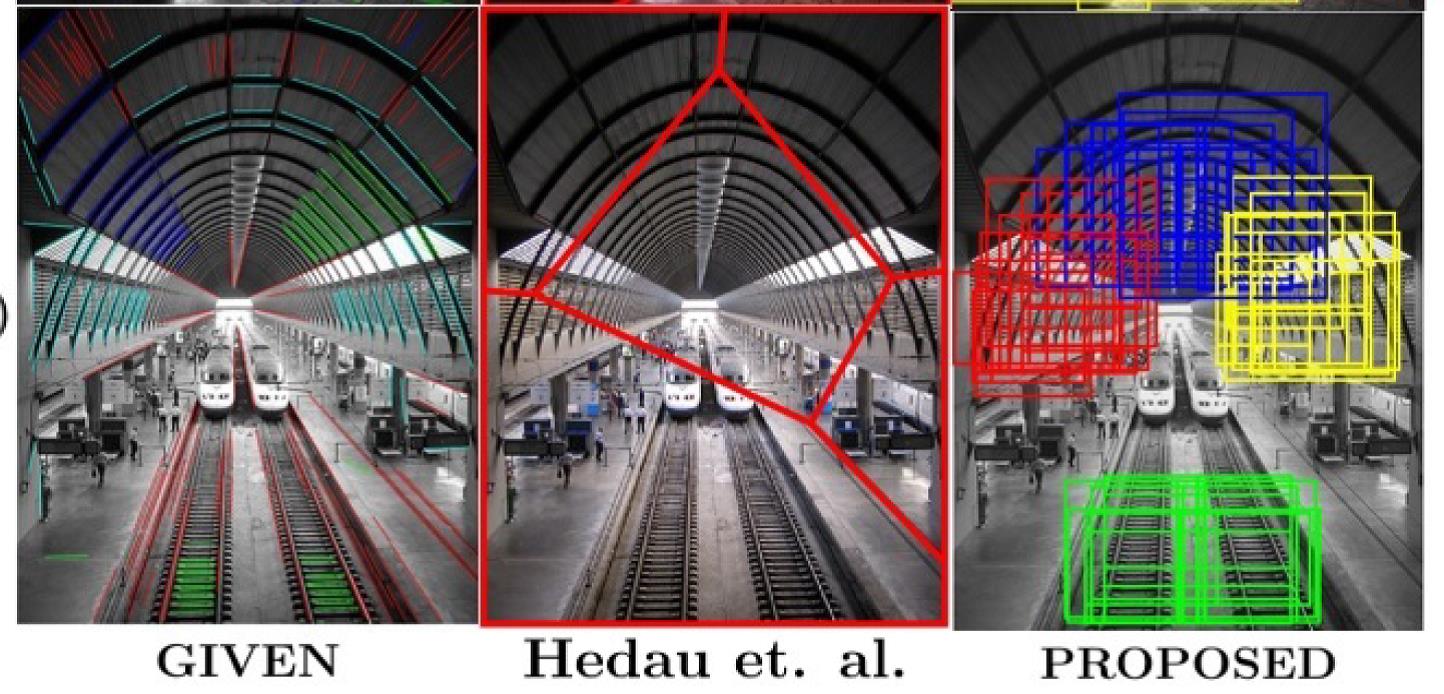
Facilitating and Exploring Planar Homogeneous Texture for Indoor Scene Understanding
Shahzor Ahmad, Loong-Fah Cheong.
European Conference on Computer Vision (ECCV), 2016 (Spotlight presentation (2.9% acceptance rate))
[PDF ][Supplementary PDF][Dataset download] [Annotation Tool]
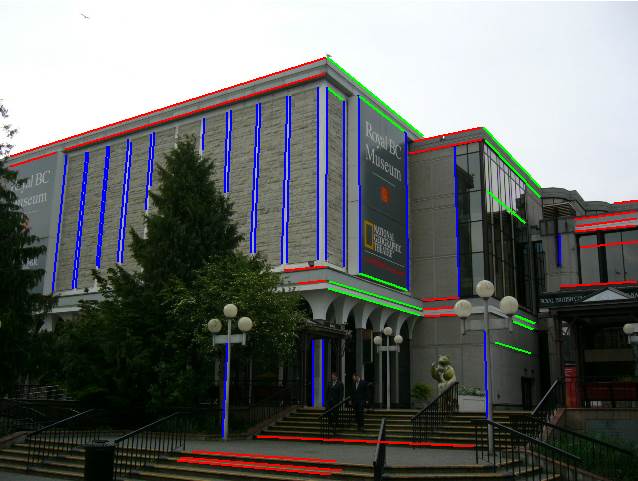
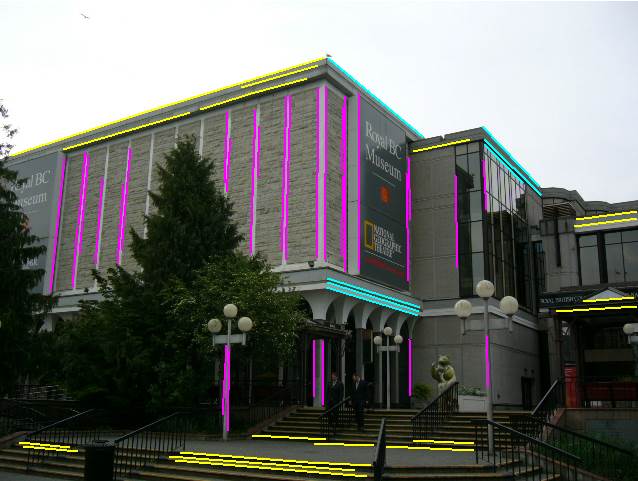
- Propose a projective-invariant method to localize planar homogeneous texture regions "in the wild".
- Provide cues for indoor geometric layout estimation (left figure).
- Facilitate scene recognition by affine rectification of textured patches.
Simultaneous Clustering and Model Selection for Tensor Affinities
Zhuwen Li, Yang Shuoguang, Loong-Fah Cheong, Kim Chuan Toh.
IEEE Conference on Computer Vision and Patten Recognition (CVPR), 2016 (Spotlight presentation (9.7% acceptance rate))
[PDF ][Supplementary PDF][Codes download]
- Given affinity matrix/tensor, perform model selection and clustering. Model selection is seldom addressed in the field.
- Translate the rank concept and the notion of positive-semi-definiteness to the higher dimensional tensor setting in a form that is tractable.
- Avoid having to construct the affinity tensor completely and instead efficiently solve via stochastic optimization in an online fashion.
Actionness-assisted Recognition of Actions
Ye Luo, Loong-Fah Cheong, and An Tran.
IEEE International Conference on Computer Vision (ICCV), 2015
[PDF (1.5MB)][Project page and codes download]
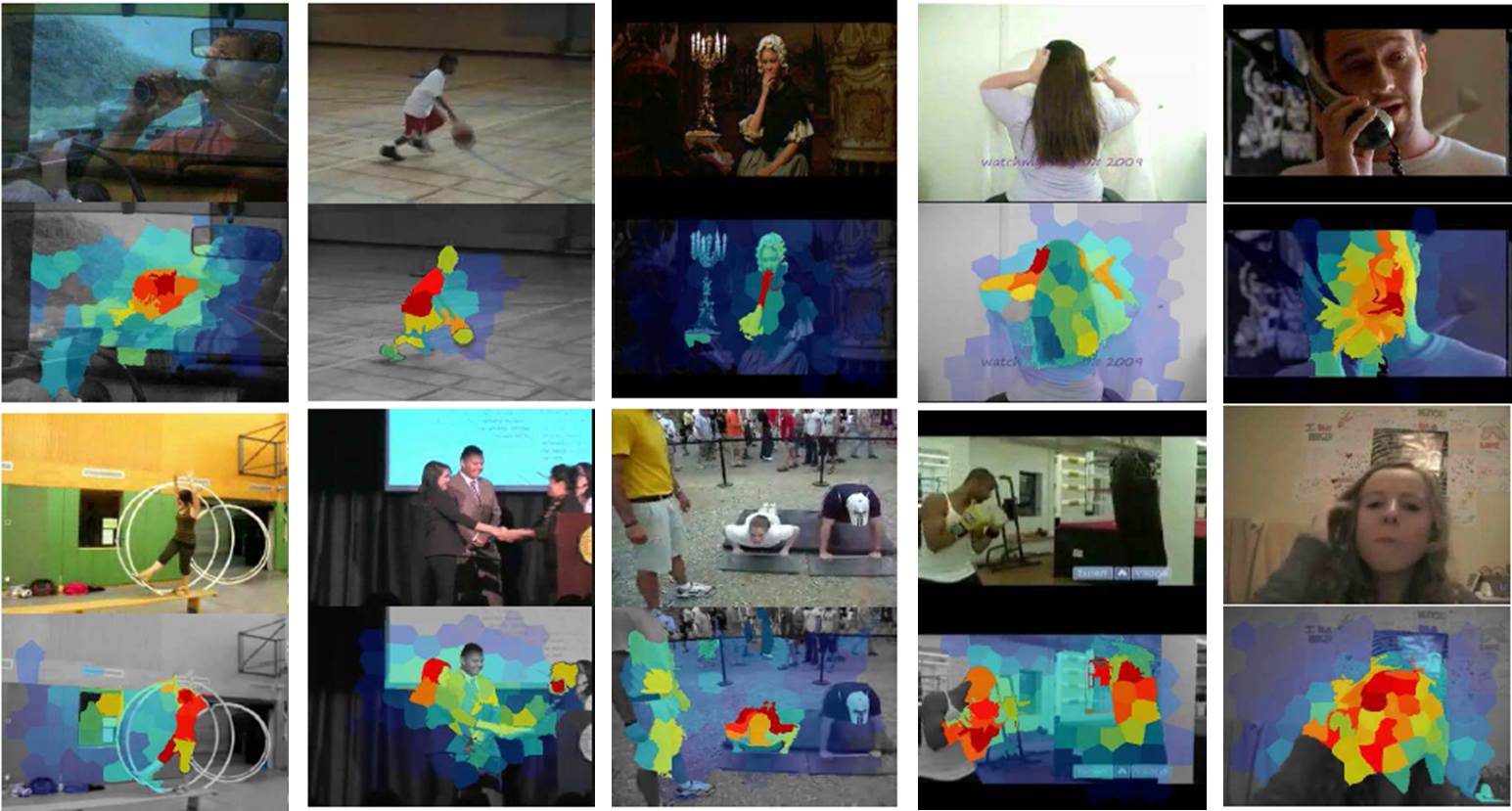
- Extract low-level actionness attributes from videos that can reveal agency and intentionality of action, independent of the action type.
- Can be used for action detection, and for implementing an actionness-driven pooling scheme to improve action recognition performance.
- Perform well in actions involving interaction, because the method groups the interacting humans or objects into a unit via temporal synchrony.
Simultaneous Video Defogging and Stereo Reconstruction
Zhuwen Li, Ping Tan, Robby T. Tan, Danping Zou, Steven Zhiying Zhou and Loong-Fah Cheong.
IEEE Conference on Computer Vision and Patten Recognition (CVPR), 2015 (Oral)
[PDF (9MB)][Presentation slides][Matlab Code] [Dataset][Results]
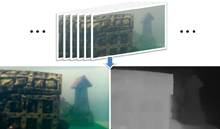
- Jointly estimate scene depth and recover the clear latent image from a foggy video sequence.
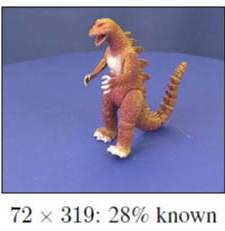
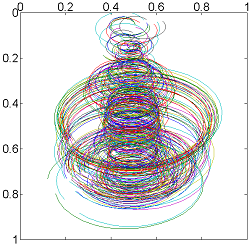
Practical Matrix Completion and Corruption Recovery using Proximal Alternating Robust Subspace Minimization
Yu-Xiang Wang, Choon Meng Lee, Loong-Fah Cheong, Kim-Chuan Toh.
International Journal of Computer Vision, 2014
[PDF (6MB)][Matlab Code]
- Can handle high % of missing data, non-random support, noise and gross corruptions.
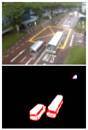
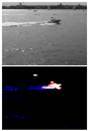
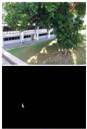
Block-sparse RPCA for Salient Motion Detection
Zhi Gao, Loong-Fah Cheong, and Yu-Xiang Wang.
IEEE Transaction on Pattern Analysis and Machine Intelligence, 2014
[PDF (1.6MB)][Matlab Code ][Video Demo 1 (69MB) ][Video Demo 2 (21MB) ]
- State-of-the-art results in 2 recent change detection benchmarks
- Can handle illumination change, bad weather, background motion, camera jitter, disparate scale
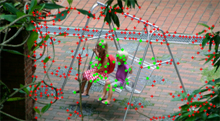
Perspective Motion Segmentation via Collaborative Clustering
Zhuwen Li, Jiaming Guo, Loong-Fah Cheong, and Steven Zhiying Zhou.
IEEE International Conference on Computer Vision (ICCV), 2013 (Oral)
[PDF (2MB)][62-clip Dataset Download (84 MB)]
- Can handle perspective effects, missing data, model selection, and yet retain elegance of formulation.
- State-of-the-art results in handling the preceding challenges
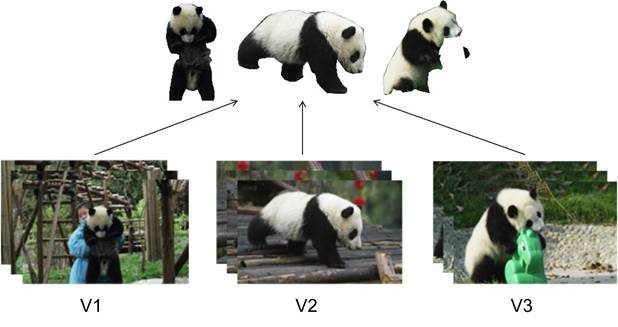
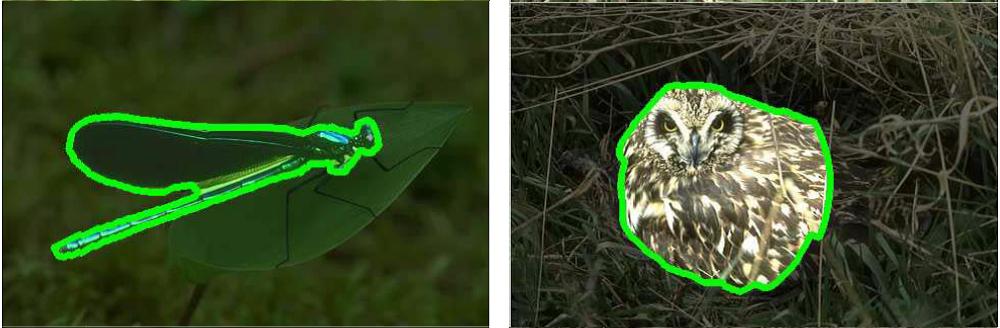
Consistent Foreground Co-segmentation
Jiaming Guo, Loong-Fah Cheong, Robby T. Tan and Steven Zhiying Zhou.
Asian Conference on Computer Vision (ACCV), 2014
[PDF (9MB)][Project page and CFViCS database download]
- Can handle foreground with variegated appearance, moving nonrigidly or consisting of multiple interacting entities (e.g. a mating pair of birds).
- Can handle cluttered background and remove extraneous objects momentarily moving together.